Leaders from Beijing, Moscow, and Minsk swiftly issued formal congratulatory messages to Myanmar’s military ruler, Senior General Min Aung Hlaing, officially endorsing his installation as the country’s president following a widely discredited electoral process.
 TZP News
The Zoland Post | April 4, 2026
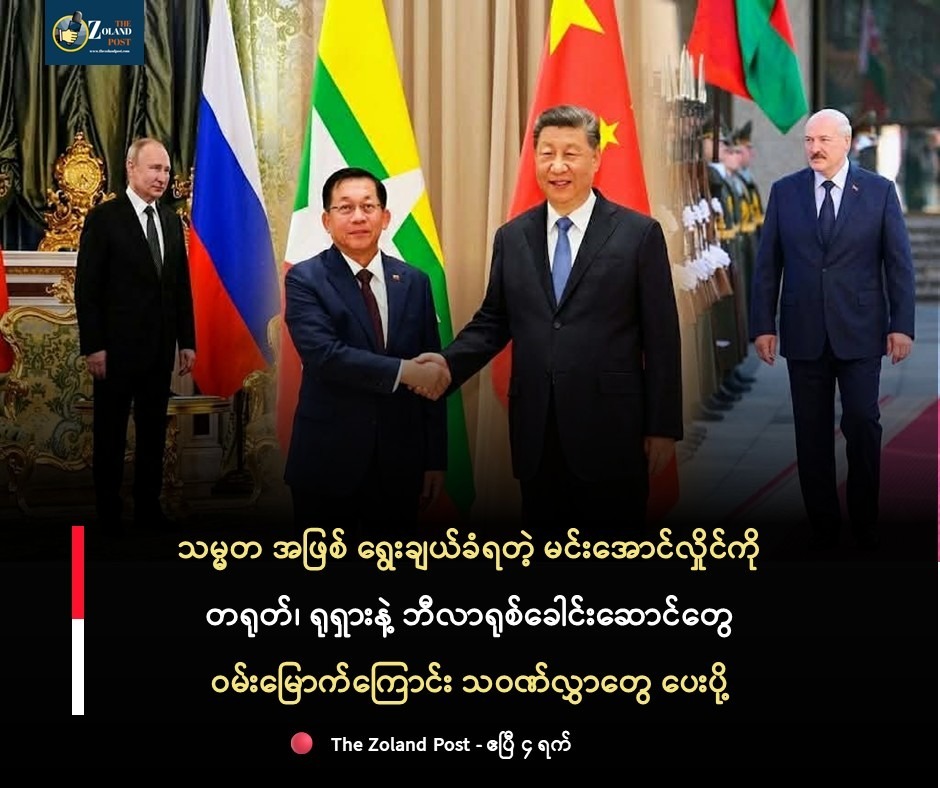
Leaders from Beijing, Moscow, and Minsk swiftly issued formal congratulatory messages to Myanmar’s military ruler, Senior General Min Aung Hlaing, officially endorsing his installation as the country’s president following a widely discredited electoral process.
The synchronized diplomatic pivot began on April 3, when Chinese Foreign Ministry spokesperson Mao Ning publicly welcomed the political transition during a routine press briefing in Beijing. The following day, Chinese President Xi Jinping, Russian President Vladimir Putin, and Belarusian President Alexander Lukashenko cemented their backing by dispatching official letters of congratulation to the newly titled head of state.
Addressing the media, Mao affirmed Beijing’s explicit support for the newly formed administration’s efforts toward national stability and economic development. She underscored China’s intent to actively advance major Belt and Road Initiative (BRI) infrastructure projects and cultivate a “China-Myanmar community with a shared future” to generate tangible benefits for both populations.
Echoing his spokesperson’s sentiments, President Xi highlighted his two direct meetings with Min Aung Hlaing over the past year. In his formal dispatch, the Chinese leader expressed his readiness to deepen mutual political trust and drive concrete, forward-looking progress in their bilateral strategic partnership.
Moscow and Minsk, both crucial suppliers of military hardware and economic lifelines to the embattled regime, offered equally robust endorsements. President Putin stated his steadfast confidence that Min Aung Hlaing’s presidency would foster constructive bilateral cooperation, benefiting both nations while purportedly bolstering security and stability across the broader Asia-Pacific region.
Similarly, President Lukashenko praised the general’s extensive governance experience and leadership acumen, predicting successful socio-economic progress for Myanmar. The Belarusian leader reiterated his strong commitment to deepening bilateral ties and proposed a future summit to discuss pressing matters of mutual interest.
This rapid succession of commendations signals immediate diplomatic validation and an intent to normalize relations from the junta’s primary geopolitical patrons. However, the broader international reception remains starkly polarized.
Underscoring the regime’s enduring regional isolation, neither immediate neighbors such as India and Bangladesh nor fellow member states of the Association of Southeast Asian Nations (ASEAN) have issued any statements acknowledging Min Aung Hlaing’s ascension through what domestic and international critics have universally condemned as a sham election.